







Selling abroad sounds like a big project: new markets, different languages, different customer questions, different expectations. In practice, the first step is much simpler today than it was a few years ago. In 2026, adding new language versions of the website, store, product descriptions or basic marketing content will be much easier for many companies thanks to AI tools.
The problem appears a moment later.
A customer from Germany enters the German version of the store and asks about delivery. A customer from France wants to know if the product is suitable for his application. A customer from Spain asks for an invoice. Someone from the Czech Republic writes on WhatsApp, someone from Italy via a form, and someone from the Netherlands via the marketplace.
The page can be translated. The offer may look professional. Ads can work. But if a company doesn’t respond quickly and naturally, sales start to slip away.
And this is where the real challenge begins: how to serve foreign customers without knowing the language, without building a large team and without pretending that an AI chatbot will replace a human?
New markets are an opportunity, but customer service is what drives sales
Expanding sales to other countries can open up a completely new source of revenue for the company. This doesn’t just apply to big brands. An online store, manufacturer, exporter, B2B company, distributor or brand with a niche product often has an offer that may be of interest to customers outside Poland.
Sometimes the company already has signals that it is worth trying:
- entries from other countries appear in the store,
- customers ask in English, German or Czech,
- products go abroad via the marketplace,
- competitors sell similar products in Europe,
- the company has logistics that allows it to send orders outside Poland,
- margins on foreign markets may be higher than locally.
In the past, translating the entire store and preparing content in foreign languages was a barrier. Today it still requires quality control, but the process is much easier. You can prepare descriptions, FAQs, categories, transactional messages and basic information pages more quickly.
This causes more and more companies to ask themselves the question: if we can have a store in German, French, Italian or Czech, why do we only sell in Poland?
The answer is most often no: because we don’t have the page translated. It’s becoming more and more common: because we don’t know who will respond to customers.
Just translating the store is not enough
A foreign customer does not just buy text on the website. He also buys the feeling that there is a company on the other side that understands his question and will help him in case of a problem.
The most common questions before purchasing are very ordinary:
- Do you ship to my country?
- How long does delivery take?
- Does this product fit my model?
- Can I get an invoice?
- Is it possible to order a larger quantity?
- Is the product immediately available?
- How much will the return cost?
- Can I pay in another way?
These are not questions that always need to be automated. Often, a quick, specific human response is enough. The problem is that the person on the company’s side usually knows Polish, sometimes English, less often German, and almost never several or a dozen languages at the level of casual customer service.
Then comes the task of manually copying the message to the translator, rewriting the response, checking the meaning of the translation and pasting the text back into the chat, e-mail or marketplace message. You can survive it with just one conversation. Ten a day gets uncomfortable. When there are several language versions of the store, it starts blocking sales.
Why AI chatbot doesn’t solve the whole problem
An AI chatbot can help in simple scenarios, but in foreign sales it should not be treated as a full replacement for a human. Many customers do not want to talk only to a bot, especially when the question concerns money, delivery date, complaint, product matching or a larger order.
The customer wants to get an answer quickly, but he also wants to feel that someone takes responsibility for the conversation. This is especially important when selling internationally, because trust is lower at the beginning. The customer does not know the brand, does not always know local opinions, is often a first-time buyer and needs additional confirmation.
A good model is not about hiding a human behind a bot. A better model is a human supported by AI.
AI can translate messages, organize communications and speed up responses. A person still decides what to answer, how to solve the problem and whether the situation requires an individual approach.
This is an important difference. The customer is still talking to the company, not to a machine. However, the team does not have to know the customer’s language to handle the call professionally.
Three popular ways of serving foreign customers and their problems
The table below shows what companies most often do after launching sales to new markets.
| Method | When it works | Where it starts to get in the way |
|---|---|---|
| Reply only in English | For B2B or technical clients who know English | In e-commerce, many customers prefer to write in their own language |
| Using Translator Manually | With a small number of messages | It takes time, interrupts the rhythm and it’s easy to confuse conversations |
| Employment of language specialists | On a large scale in a specific market | It is expensive, difficult to organize and does not cover all languages |
| AI Chatbot | With simple questions and repeatable processes | It does not replace a human in sales, technical and problem-solving conversations |
| Human plus automatic translation | With sales to multiple markets and an increasing number of conversations | Requires a good tool that translates at the point of conversation |
The most practical solution for many companies is not a large service department in several languages and not full automation. It’s a simple process: the customer writes in his language, the employee sees the content in English, responds in English, and the customer gets the answer in his language.
What may foreign customer service look like without knowing the language
Imagine a store that sells to several countries. It has Polish, German, French and Italian versions of the website. The service team works in English.
A customer from Germany writes:
Ist der Versand nach Österreich möglich?
The employee sees the message in English:
Czy możliwa jest wysyłka do Austrii?
Answers in English:
Tak, wysyłamy zamówienia do Austrii. Koszt dostawy zobaczy Pan po wpisaniu adresu w koszyku. Standardowo wysyłamy paczkę po zaksięgowaniu płatności.
The customer receives a response in his own language.
The whole conversation stays natural. The employee does not switch to a separate translator. Does not copy text between tabs. He doesn’t wonder where he pasted the last message. He can focus on what’s really important: whether the customer got an answer that helps him buy.
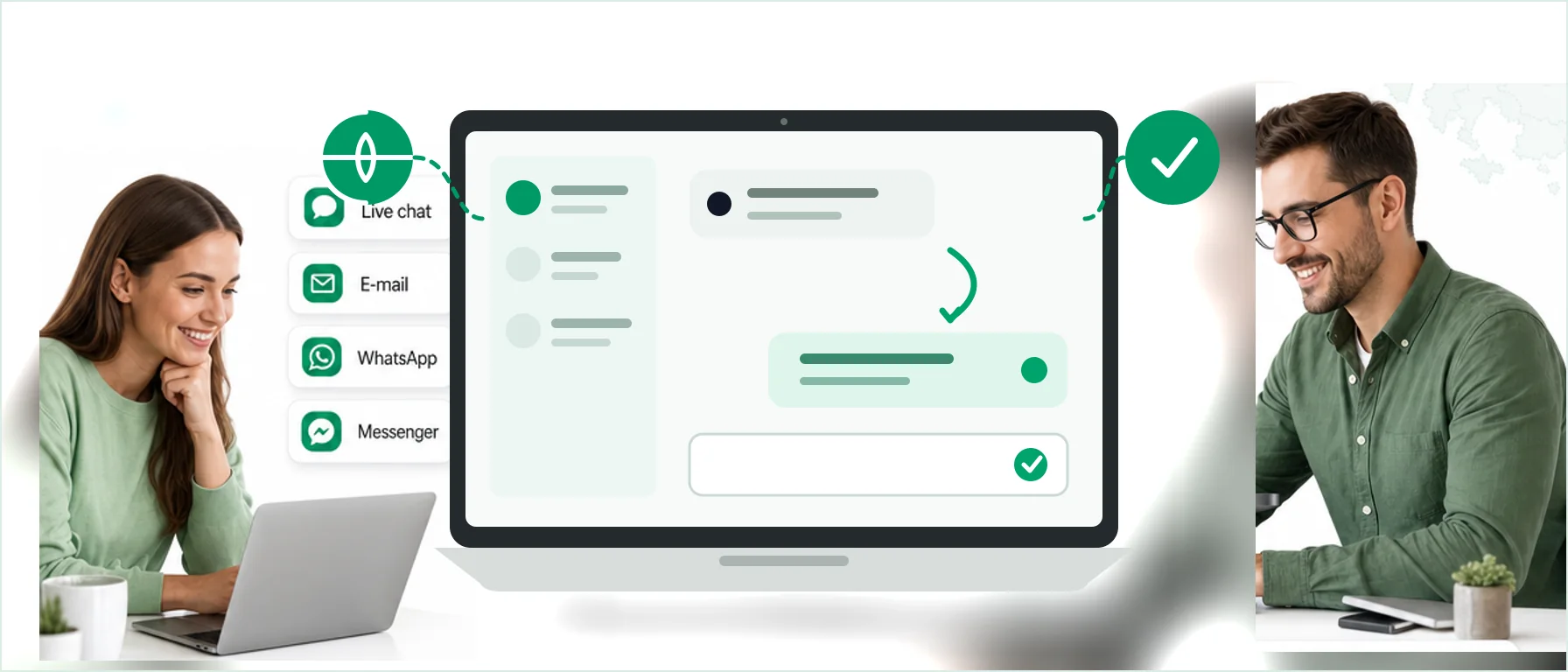
This makes a huge difference in everyday work. Especially when messages come not only from live chat, but also from e-mail, Facebook, Instagram, WhatsApp, marketplace and several language versions of the store.
Example from practice: a store in multiple languages is just the beginning
A good example is the situation behind the development of Chataptor. BROWIN started mainly with sales in Poland. Over time, orders from Germany and individual parcels to other European Union countries appeared. The company saw that logistics were no longer a big barrier. Couriers could deliver parcels around Europe in a few days, so limiting sales only to Poland made no sense.
The store has been translated into many languages. New domains and language versions have been created. Product descriptions, guide content and store elements have been translated. After a few months, foreign sales began to grow organically because customers were more willing to buy when they saw the store in their language.
But growth brought a new problem: customers began writing in multiple languages. The team needed one place for conversations from different language versions, automatic translations and country-specific responses.
This is a very typical stage of development. First, the company thinks: we need to translate the store. Then he discovers: we still need to serve the people who will start using it.
Checklist: is your company ready to sell abroad?
You don’t have to start with a big expansion. You can check your company’s readiness with a simple checklist.
Offer and logistics
- Can you ship products to selected countries?
- Is the delivery cost clear to the customer?
- Can you estimate the approximate delivery time?
- Do you have a described return policy for foreign customers?
- Do you know which products are best for starting?
Website and content
- Are the most important store pages available in the customer’s language?
- Are the descriptions of top products understandable after translation?
- Are the basket, delivery and payment described clearly?
- Does the customer see that the store serves his country?
- Does the FAQ answer basic questions about shipping, returns and payments?
Customer service
- Do you know where messages from foreign versions of the website will be sent?
- Can the team respond to a customer without knowing their language?
- Are messages from live chat, e-mail, social media and marketplace in one place?
- Do you have ready answers to questions about delivery, returns, invoice and availability?
- Can you also serve customers from the phone when you need to respond quickly?
If there is uncertainty about some of the questions, it is a good time to organize communication before a larger foreign campaign. You can get traffic from advertising or SEO. It’s worse if the company then loses inquiries because there is no service process.
How Chataptor helps you sell abroad without knowing any languages
Chataptor is a customer communication tool that helps companies handle conversations faster and more conveniently. It’s not just a simple chat widget. It can act as one customer service panel where you collect messages from many places.
In the context of foreign sales, three things are important.
1. The customer can write in his own language
The customer does not have to switch to English or wonder whether he will be understood. He can write however he feels most comfortable. This lowers the contact barrier and makes the conversation look more natural.
2. The team can read and respond in English
The employee does not need to know German, French, Italian or Dutch. He can read the message in English, prepare a reply in English, and the customer will receive it in his own language thanks to automatic AI translations.
This removes the most annoying element of working with foreign news: manually copying texts into the translator.
3. Messages from different channels arrive in one inbox
Customers rarely write through only one channel. Some will choose chat on the website, others will choose e-mail, Facebook, Instagram, WhatsApp, Amazon, Allegro or another marketplace channel. If a company has several domains or language versions, chaos grows even faster.
Chataptor allows you to collect customer communications in one place. This saves the team from having to jump between applications and check each inbox individually. This is especially important when selling abroad, where it is easy to confuse the language, country, store or delivery rules.
Ready-made answers help keep order in many markets
Translations solve the language problem, but they do not solve everything. The company still needs to respond consistently. Delivery to Germany may be different, to France or to Italy. Return policies or processing times may vary.
In Chataptor you can use message templates and quick command responses, for example:
/dostawa- shipping information,/zwrot- return policy,/faktura- response about the invoice,/oferta- response to the request for quotation,/chwila- short information that you are checking the case.
Example:
The employee enters:
/chwila
Chataptor inserts:
Już to sprawdzam. Proszę o chwilę cierpliwości.
When selling internationally, templates can be tailored to websites, domains, countries or language versions. If the call comes from the German version of the store, the delivery reply may refer to the German market. If the client writes from the French version, the team can use a different template.
This helps avoid a situation in which a customer from one country receives information prepared for another market.
A simple plan to enter a new market with human customer service
If you want to sell abroad, you don’t have to launch twenty language versions at once. A calm start and a good service process are better.
Step 1: Select one or two test markets
Don’t start with all countries at once. Choose the market in which you have the greatest chance: there are visits to the website, you know logistics, you have competition or the product fits local demand.
Step 2: Translate the most important elements of the store
The most important things to start with are: categories, top products, basket, delivery, payments, returns, contact and FAQ. You don’t have to have your entire blog perfectly translated to check the market potential.
Step 3: Add a visible contact and live chat
If a customer has a question, they should easily find a way to contact you. Free live chat on your website helps you answer questions that might otherwise cause the customer to leave without buying.
Step 4: Collect messages in one panel
Don’t spread support across several boxes and applications. The more languages and channels, the more important a single customer service inbox is.
Step 5: Enable automatic translations
Make sure that the employee does not have to manually translate each message. Serving foreign customers without knowing the language makes sense when the translation takes place at the place of conversation.
Step 6: Prepare response templates
Start with the 10 most common questions: delivery, return, invoice, order status, availability, discount, larger quantity, payment, complaint, product matching. This is enough to significantly speed up the first conversations.
Step 7: Analyze customer questions
Messages from foreign customers are not only about service. It is also a great source of market knowledge. If many people are asking about the same product, shipping costs or instructions, you know what to improve on the site.
Biggest mistake: putting off customer service
Many companies only think about service once the campaign is up and running and the messages start pouring in. It’s risky. A foreign customer often needs more certainty before purchasing than a local customer. If he doesn’t get a response quickly, he may choose a store that looks more accessible.
It’s not about having a perfect service department from day one. The point is not to create an artificial barrier. Since the customer can already read the offer in his language, he should also be able to ask a question in his language and get a normal answer.
Chataptor helps you build such a process without high entry costs. It is 100% free, with no limits and no paid features. You can use it as a free live chat, one panel for customer messages, an automatic translation tool and a system supporting multiple language versions of the store.
If you are planning to sell abroad, start with a simple question: will a customer from another country be able to write to us today in his own way and get a sensible answer without waiting?
If the answer is no, now is a good time to clean up your communication.
FAQ
How to serve foreign customers without knowing the language?
The simplest model is automatic conversation translation. The customer writes in his language, the employee reads the message in English, replies in English, and the customer receives the answer in his language.
Is an online store in multiple languages enough to sell abroad?
Not always. A translated website helps attract customers, but sales often depend on quick answers to questions about delivery, product, returns, invoice or availability.
Can an AI chatbot replace customer service in foreign sales?
A chatbot can help with simple questions, but it should not completely replace a human. In sales, technical and problem-solving conversations, the customer often expects contact with a person who understands the situation and can make a decision.
What are the benefits of live chat with translation?
Live chat with translation allows the customer to write in their language and the team to respond without manually using a translator. This speeds up conversations and reduces the contact barrier for customers from other countries.
Is Chataptor suitable for supporting several language versions of the store?
Yes. Chataptor can help you handle messages from multiple sites, domains, and languages. The team can work in one panel and use automatic AI translations.
Is Chataptor free?
Yes. Chataptor is 100% free, with no limits and no paid features. It can be used as a free live chat, customer service inbox and a tool for communicating with customers from multiple channels.
What information is worth preparing before entering a new market?
To start, it is worth preparing response templates about delivery, returns, invoices, order status, product availability, payments, complaints and requests for quotation.
How to start selling abroad if the company does not know the languages?
It is best to choose one test market, translate the most important store pages, add a visible contact, launch live chat with translation and prepare templates for answers to the most common questions.
Summary
Selling abroad doesn’t have to start with hiring a team that speaks multiple languages. In 2026, it will be much easier to prepare the store, offer and content in new language versions. The real question is who will serve customers and how when they start writing?
The best direction is not to pretend that a bot will replace a human. A better direction is a human supported by AI: automatic translations, messages in one panel, ready-made answers and fast service without switching between tools.
If you want to open your company to new markets, you can start simple: add a free live chat, collect messages from customers in one place and test automatic translations in Chataptor. The client writes in his own way, the team responds in English, and the conversation remains human.
Keep reading
Related guides
Best free live chat tools in 2026: feature comparison
Compare the best free live chat tools in 2026, including conversation limits, agent seats, AI features and costs for Chataptor, tawk.to, Tidio and more.
The most expensive customer message is the one no one noticed
A missed customer message can mean a lost sale, complaint or relationship. See why messages disappear and how a shared inbox helps prevent it.
A simple customer support tool for everyone
Online customer support does not need a large support team or technical setup. See how Chataptor helps companies reply faster from one simple place.